Protect the book. Control the access.
Most large-scale ebook piracy does not begin by breaking platforms. It begins when a complete book file reaches a user’s device, is extracted, converted, and redistributed.
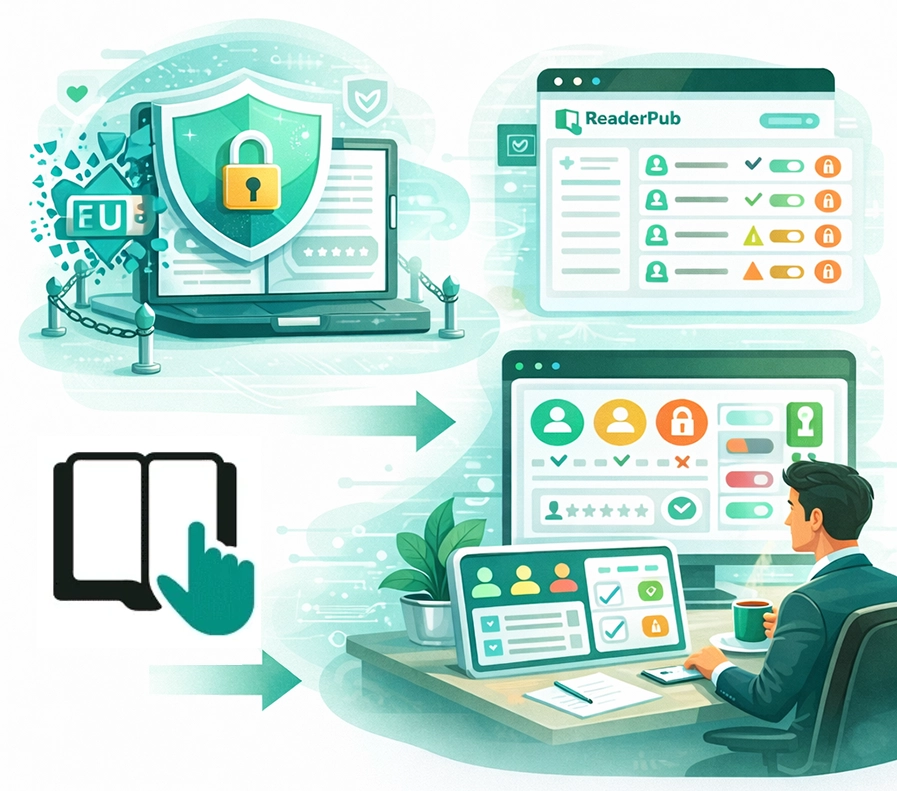
ReaderPub reduces that risk by keeping reading access on the web instead of delivering a downloadable file — while giving you full control over who can access your content and how it is distributed. Web-accessible editions are fully protected against downloading or copying.
How file-based piracy scales
In traditional ebook distribution, a complete file is delivered to the end user. Once that file exists on a device, it becomes the starting point for extraction, conversion, and redistribution.
File delivered
A complete ebook file reaches the reader’s device.
File extracted
The file becomes available for copying outside the original platform.
File converted
It can be turned into standard ebook formats for reuse.
File redistributed
Once a reusable file circulates, redistribution can scale quickly.
This pattern is repeatable, automatable, and widely used across the industry.
ReaderPub uses a different model
ReaderPub does not rely on post-delivery file control as its primary protection model. Instead, it minimizes risk before delivery by avoiding standard downloadable-file distribution for the primary reading edition.
- No downloadable primary EPUB delivered by default
- No standard full-book file handoff to the reader
- Web-native access through controlled accounts
- Fully protected web-accessible edition publications
- Lower risk of scalable extraction and mass redistribution
Control who reads — and how your content is used
ReaderPub gives institutions full control over access to their publications. You decide who can read, under what conditions, and at what level of visibility — from fully public access to restricted, account-based distribution.
Access is not only protected at the content level, but also managed at the platform level through administrative controls and structured user access.
- Define who can access each publication or collection
- Use account-based access for controlled distribution
- Manage teams, roles, and permissions centrally
- Maintain full visibility across all your published content
Protection is not just about preventing extraction — it is about controlling distribution end-to-end.
Why this matters to authors and publishers
When a book is distributed as a file, protection depends on controlling what happens after delivery. In the real world, that model has repeatedly led to commercial ebooks circulating outside their original platforms.
ReaderPub addresses the problem earlier in the chain: by not delivering the primary reading file in the first place, it removes the standard entry point used in large-scale redistribution workflows.
File-based distribution
- A complete file reaches the device
- Protection begins after delivery
- Extraction risk remains part of the model
- Redistribution can scale once a file circulates
ReaderPub
- Primary access stays on the web
- No standard downloadable primary file
- Risk is reduced at the architectural level
- No routine file handoff to each reader
A practical, honest security position
No digital system can prevent every form of copying. Screenshots, manual capture, and other low-efficiency methods can still exist.
But ReaderPub removes the most scalable starting point for large-scale piracy: delivering a complete, reusable ebook file to the end user. At that, the web-accessible editions are fully protected against downloading or copying.
ReaderPub’s primary distribution model is web-native. When needed, we can also produce a production-ready EPUB for archival use, external distribution, or additional publishing workflows — without making routine end-user file delivery the default model.